
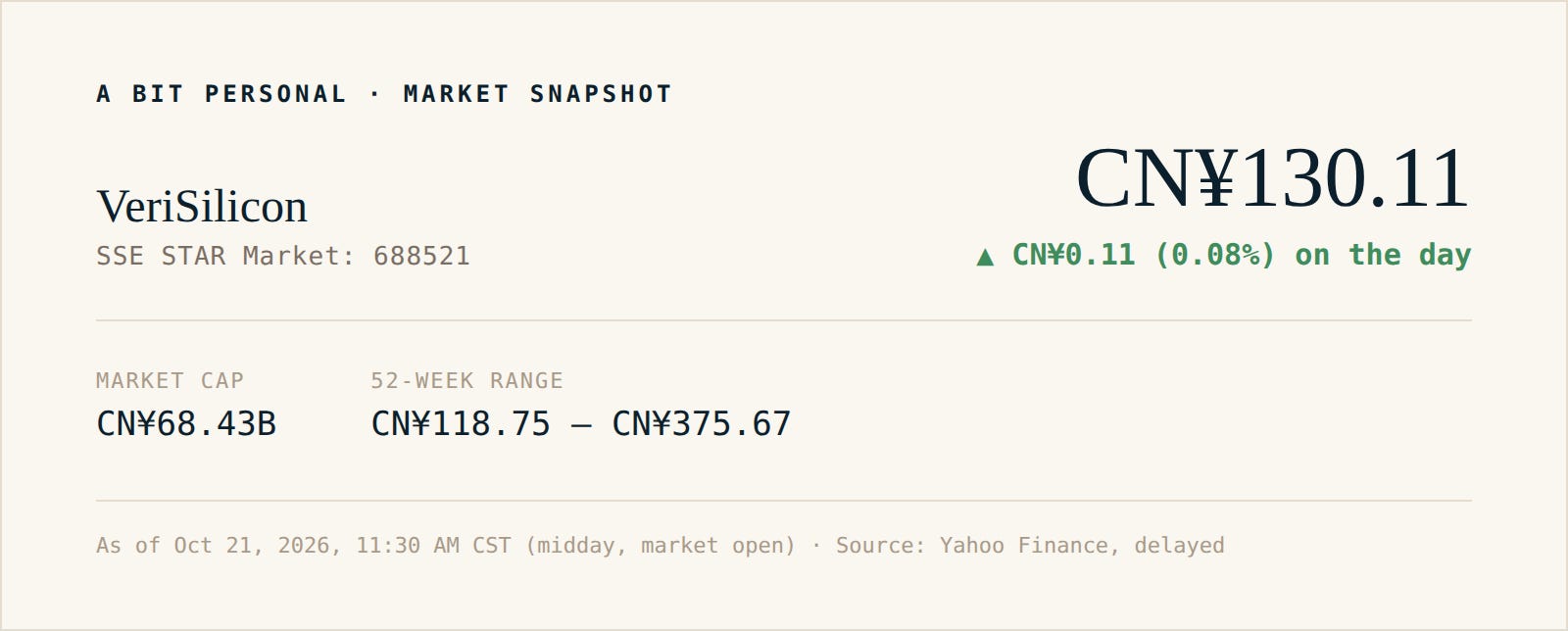
This week I have something special for you…I released this episode last season but think it deserves another post. Wayne Dai builds his company around a simple order: customers first, employees second, owners last. He is the founder, chairman and CEO of VeriSilicon, a Shanghai chip design company, and he told me how a childhood in Shanghai, a computer lab at Berkeley and a professor’s life shaped the way he treats people. Along the way he talks about why he is against the “996” work schedule, how he hires, and what a toy that tells stories offline says about where AI is going.
From farm work in Shanghai to a Berkeley computer lab
Wayne grew up in Shanghai near the end of the Cultural Revolution, the oldest of three kids who were sent to school together and learned to be independent early. As a child he swam across the Huangpu River, and since his parents had to sign a permission slip, he signed for them. Before the national exam resumed, he spent three years doing farm work on Chongming Island.
When he reached the United States, he had never seen a computer. He chose computer science, he says, mainly for the job: someone told him physics might leave him teaching high school. At Berkeley he and his brother and sister were, in his words, among the first students from mainland China there. He met his wife in the computer lab, and his brother and sister and their spouses all ended up in computer science and semiconductors too.
The professor who ran a small company
At UC Santa Cruz, Wayne says, a professor in the United States runs something close to a small business. You raise your own funding, you pay your students, and you have six years to earn tenure. Half of the money you bring in goes to the school.
The part that stuck with him is picking the right problem. He told his students to choose a topic that will matter when they graduate four or five years later, not the one that is hot today. Solve the first 20 percent of a new problem, he says, and you have solved 80 percent of it. He applied the same instinct when he left campus to build VeriSilicon, and for years he commuted between California and China while still supervising more than ten PhD students.
The FCS Rule: Fair, Care, Share
Wayne describes VeriSilicon’s culture in three words. Fair: his receptionist and his driver have stock options, which he says is unusual in China. Care: the company cares about employees’ kids, and he says some children tell their parents not to leave. Share: senior people mentor the young ones, so fresh graduates grow fast.
He is also against the “996” schedule (9 a.m. to 9 p.m., six days a week). From day one, he says, he did not want people missing the years when their kids are three and five. The company has a family day and a summer school, and its New Year party draws about 3,000 people with their families. It started in 2008, when many companies cancelled their holiday parties and he told everyone to bring their kids, with an iPod shuffle for each child as a gift.
Integrity first, capability third
When Wayne hires, his order is integrity first, attitude second and capability third, because capability can be taught. The process is demanding: from about 10,000 people who take a written exam, around 1,500 are interviewed. Each goes through six rounds, including a technical round, two with HR (one fully in English, since 30 to 40 percent of the business is outside China), and a final interview with him.
He has a theory about teams too: start with an A team and it will hire A people, start with B and it will hire C. If the A people leave, he says, that means you are a B and have to change. His CEO shorthand is the same idea in order: C is customer, E is employees, and the owners come last.
AI, small models and the big picture
Wayne ran an experiment this year: a three-day design contest in which two teams knew AI very well but nothing about chips. They had to use AI tools to do the work. The first results were wrong, and the teams struggled, but in the end they got everything right. He says it came earlier than he expected, and next year anyone who does not know AI will be on their own.
He also sees AI moving out of the data center. With Google, VeriSilicon has worked on small open-source models, and he showed me an offline toy that turns a few keywords into a bedtime story, with no Wi-Fi or phone needed. His advice for anyone building a career is the best advice he ever got, from his PhD advisor: keep the big picture in view and do not get stuck on small things.
Try this week:
Wayne’s order is customers, employees, owners. Write down the three people your work serves and put them in order. Then pick one small thing you can do this week for the person you put last.
Keep reading
VeriSilicon and Google Jointly Launch Open-Source Coral NPU IP from Business Wire (November 10, 2025). The Google collaboration Wayne mentions: an open-source chip design for low-power, always-on AI in devices like wearables, which connects to his offline story toy.
The Landmark IPO of VeriSilicon on the Shanghai STAR Market. VeriSilicon’s own announcement of its August 2020 listing, and what the company does: custom chip design services and semiconductor IP licensing.
Chinese officials call 996 work schedule illegal from TechNode (August 27, 2021). Background on the 9 a.m. to 9 p.m., six days a week schedule that Wayne says he has opposed from day one.
This episode is proudly sponsored by Silicon Box!


