

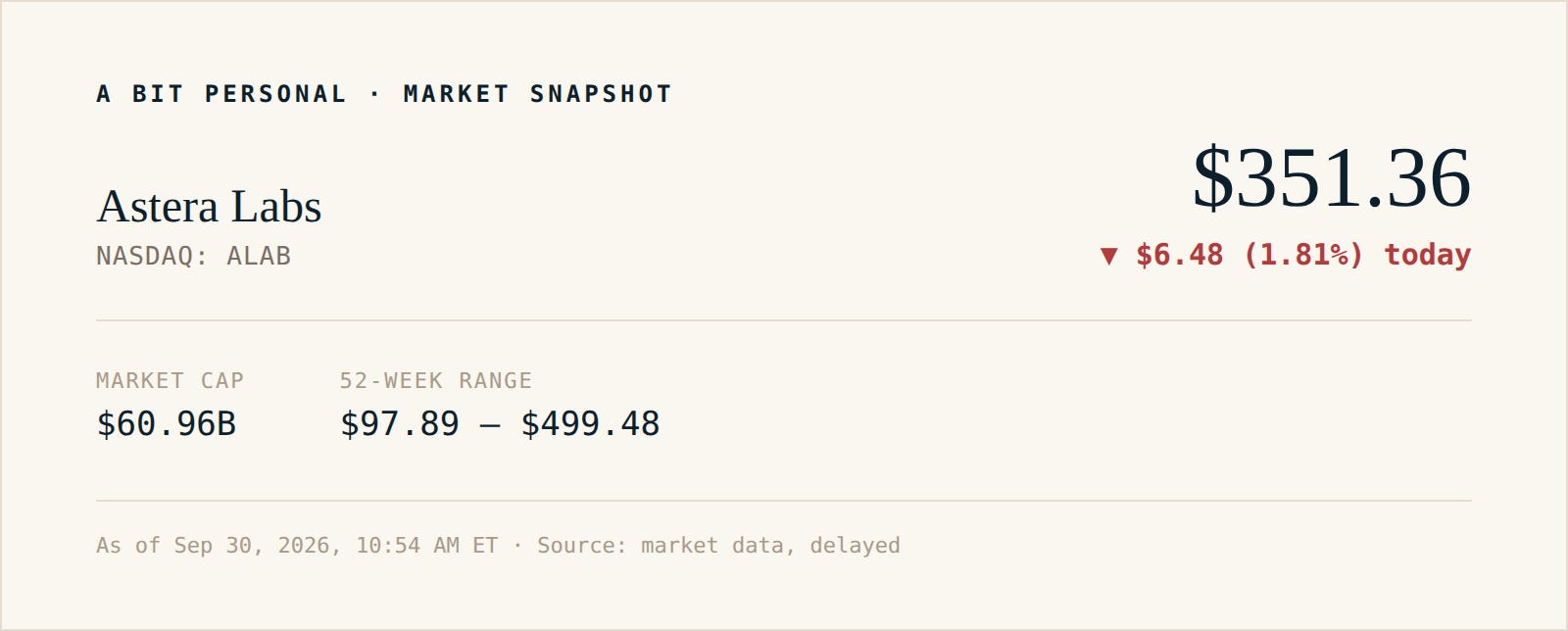
Astera Labs makes the connectivity chips that let thousands of GPUs talk to each other fast enough to keep AI systems running at full speed, the infrastructure sitting underneath everything from large language models to hyperscale data centers. In March 2024 the company went public in one of the most successful semiconductor IPOs in years, and two years later its three founders were named EY World Entrepreneurs of the Year, in the same company as Jensen Huang and Michael Dell. But I didn’t invite Jitendra Mohan, Sanjay Gajendra, and Casey Morrison on to talk about chips. I wanted to know how three people build enough trust to leave secure careers together, disagree constantly, and come out the other side still friends, still partners, and still building. What they told me isn’t really a startup story. It’s a set of habits anyone trying to build something, a company, a team, a career, could use.
Proudly sponsored by Morgan Stanley
In our conversation, we get a bit personal and discuss:
Why they built trust for over a decade before they ever needed it, and what that means for anyone picking who to go into business with
The different ways each of them sizes up risk, and why having all three on a team beats having three of the same
Why they treat disagreement as a feature of good decisions, not a problem to manage around
What “no ego” actually looks like day to day, and why it’s a discipline, not a personality type
How a new executive’s first day revealed what their culture had actually built, without anyone performing for her
The three-step philosophy their chairman calls “old-fashioned,” and why they never outgrew it
Why staying a “builder” after a successful IPO takes more intention than staying one before you had anything to lose
Keep Up With Astera Labs:
Astera is hiring at Astera Careers!
Referenced:
EY World Entrepreneur of the Year
Recommended Reading:
Astera just expanded its Leo memory controller family with three new products aimed at the memory crunch agentic AI is creating, including one that lets data centers reuse existing DDR4 DIMMs instead of replacing them. Astera says the lineup delivers up to 62% faster time-to-first-token and 22% more tokens-per-second for inference.
The Marginalian: David DeSteno on the Truth About Trust
A review of psychologist David DeSteno’s research on how people actually judge who to trust (it’s not the handshake or the eye contact you think it is), which is a useful lens for the decade of small bets Jitendra, Sanjay, and Casey put in before they ever started a company together.
Stanford: Noam Wasserman on "A Co-Founder Dilemma"
A filmed Stanford talk from the author of The Founder’s Dilemmas, on how founding teams navigate the moments when partners want different things.
Tom Tunguz: Disagree and Commit
A venture capitalist’s take on why letting a decision get made, even one you argued against, beats relitigating it forever.
Jodi’s Biggest Takeaways:
Most founders give me one rehearsed version of their company's story. These three gave me three different versions of the same decade, and let each other interrupt to correct the details. Here's what stuck with me, and what I think is usable if you're trying to build anything with other people.
1. Trust Isn’t Built in the Crisis. It’s Spent There.
By the time Astera Labs existed, Jitendra, Sanjay, and Casey had already spent over a decade solving problems together inside National Semiconductor and then Texas Instruments. The confidence to eventually risk everything on their own company didn’t come from a pitch deck, it came from years of smaller bets that had already paid off. If you’re choosing who to build something with, this is the actual test: not whether you like them, but whether you’ve already been through enough small fires together to know how they behave under pressure. Jitendra put his own spin on it, describing how differently each of them handles risk: “Sanjay will jump. Then he’ll probably look down and say, okay, where am I gonna land. I will go to the edge and I’ll look, is there water there, do I know how to swim, will I survive. And then I will jump. Casey will jump because I tied a rope to his legs.” The lesson isn’t that everyone should take risks the same way. It’s that a team of three different risk profiles is sturdier than a team of three people who’d all jump, or all hesitate, together.
2. No Ego Is Something You Practice, Not Something You Have
The honest version of a good partnership isn’t harmony, it’s disagreement that doesn’t turn personal. Sanjay described it plainly: “The goodness, I think, for three of us is the respect and trust and no ego. He could make a point, get away with it, I’m not gonna hold it against him.” That’s a practice, not a trait: letting someone win an argument and choosing not to keep score. Jitendra told me that when the three of them disagree and one direction wins out, the group’s call has been right, by his account, every single time, more often than any one of them would have landed on alone. If you want a gut check for whether your own team has this, look at what happened the last time someone’s idea won and someone else’s lost. Did the losing argument get held against them later? If disagreement doesn’t cost anyone anything, it’ll keep happening, and that’s the point.
3. “Builder” Is a Daily Choice, Not a Company Stage
Astera now calls itself a public startup, and Sanjay was clear about what that phrase has to actually mean to be true. “Anytime there’s a challenge or opportunity, we don’t think about how big or complex it is. We think about how do we solve it. That builder mindset is what has allowed us to get so far. In fact, that’s who we are. We are builders.” It’s easy to have that instinct when you have nothing to lose. The harder, more useful version of it is keeping that instinct once you have a lot to protect. Their chairman, an early investor the three of them call the godfather of the company, reduces the whole philosophy to three steps: build products customers like, sell them for a profit. It’s almost too simple to write down, which might be exactly why it still works.
Looking for more insight into semiconductors and tech leadership? Follow us on Instagram and Linkedin to get A Bit Personal right in your feed.


